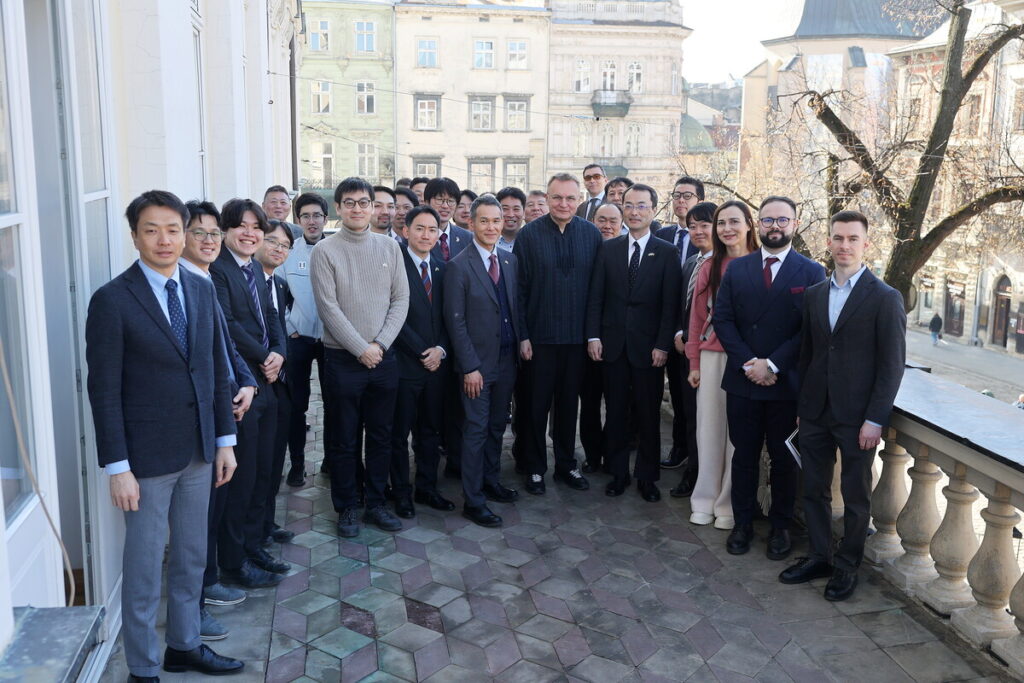
More than 20 entrepreneurs and government representatives visited Lviv as part of a Japanese business mission. This is already the fourth large Japanese delegation to visit Lviv as part of the Japan Desk Lviv initiative.
The delegation first visited the capital of Ukraine and then traveled to Lviv to meet with local companies. The main goal of the visit was to promote the involvement of Japanese technologies and private investment in Ukraine’s reconstruction through direct dialogue between Japanese and Ukrainian businesses.
During their stay, the Japanese partners met with Lviv City Mayor Andriy Sadovyy, who presented the city’s key development priorities and introduced the UNBROKEN ecosystem being developed in Lviv. The meeting focused on potential areas of cooperation in infrastructure recovery, urban development projects, and the implementation of innovative technologies. The delegation also met with representatives of 16 local companies working in related sectors to establish connections and explore future cooperation opportunities.
The Japanese delegation included representatives of companies such as Fujita Corporation (remote construction and consulting in railway, road, and bridge infrastructure), Nippon Koei / ID&E Holdings (engineering and infrastructure solutions, planning and implementation of large-scale infrastructure projects), Infrastructure Development Institute – Japan (project identification and development, as well as technical training for engineers), and Deloitte Japan (consulting and support for international infrastructure projects).
“This is my first visit to Ukraine. I expected to see more destroyed buildings and infrastructure, but instead I saw that people continue to live — I saw the resilience of Ukrainians. Because Ukraine is a democratic country and due to the resilience of its people, we must cooperate. I expect that more businesses will become involved in Ukraine now and after the war. There are many opportunities here for cooperation both in business and other areas,” said Shintaro Hori, Advisor to the Secretariat of the Cabinet of Japan (infrastructure export and economic cooperation).
“We want to cooperate with Ukrainians to rebuild Ukraine. Although our company does not yet have many offices or partners in Ukraine, we would like to establish them,” said Daisuke Nakayama, General Manager of the Nippon Express Group.
“This is already the fourth large Japanese business mission to Lviv and the second one involving a Japanese ministry, which indicates a growing interest of Japanese business in Ukraine and in Lviv as a reconstruction hub. Cooperation through Japan Desk Lviv enables a structured dialogue between the city, Ukrainian businesses, and Japanese companies, allowing for discussions of concrete projects and the presentation of the city’s infrastructure needs,” said Nazar Bilyk, Project Coordinator of Japan Desk Lviv at the Investment and Projects Office of Lviv City Council.
There are already first results of this cooperation: Japanese companies are ready to participate in municipal infrastructure projects, particularly in the development of the UNBROKEN ecosystem. A notable example is Daiwa House, which is implementing a housing project for cancer patients in Lviv. This represents an important step toward long-term strategic partnership and the introduction of advanced technologies in remote construction and disaster recovery.
It is worth noting that the JUPITeR (Japan-Ukraine Platform for Infrastructure Development and Reconstruction) platform was launched in January 2025 to attract Japan’s private sector and advanced technologies to the reconstruction of Ukraine’s critical infrastructure, housing, and transport networks. The initiative was launched by Japan’s Ministry of Land, Infrastructure, Transport and Tourism (MLIT) with the support of Deloitte Japan.
A particular focus is placed on applying Japan’s expertise in disaster recovery — rebuilding after large-scale catastrophes. One of the platform’s key objectives is to coordinate Japanese companies interested in operating in Ukraine. More than 190 companies have already joined the initiative, and opportunities are being explored to implement innovative construction technologies, including solutions for remote or automated execution of works.